In the process of tuning the temperament using the Go A.P.E. System, we first measure the inharmonicity of two octaves; A3A4 and F3F4.
The process tunes these octaves very accurately; so accurately that we are able to know whether we need to tune a pure 4:2 or a wide 4:2, and by how much!
But the real reason we measure the inharmonicity is to know how to tune F#3 and A#3 when we come to that step in the process. They are tuned differently depending on the inharmonicity of the piano we are tuning.
The process requires us to tune a pure 4:2 first. (M3 =M10). Then we check the 6:3 (m3/M6 test)
The ideal size results in a pure 6:3 (small scale), narrow 6:3 (medium scale), or a very narrow 6:3 (large scale).
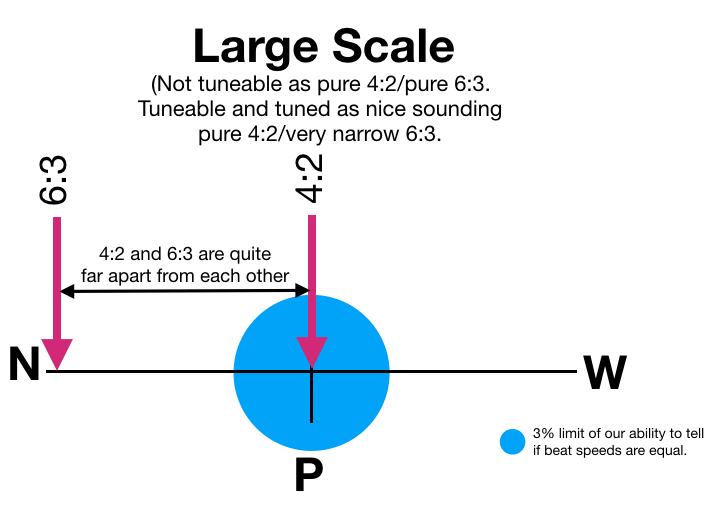
The name of the scales has to do with how far apart the 4:2 and 6:3 are from each other. It is a small, medium, or large difference.
In tuning and testing for pureness, we guess at whether or not the test intervals are the same size.
Pure 4:2 (M3 = M10)
Pure 6:3 (m3 = M6)
However, we are not able to consistently set or judge equal beat speeds closer than 3% different. (You can prove this for yourself by trying the Beat Speed Difference Sensitivity Test)
Graphical Depictions of Different Octave Inharmonicities.
Notice two things:
1) The distances between the 4:2 and the 6:3 are different and the name of the inharmonicity (small, medium, and large) comes from that distance.
2) The blue dot represents the limit of our ability to hear different beat speeds.
For example, if the 4:2 size is wide, i.e., M3 < M10, but the difference is less than 3%, we will not be able to tell, and we will judge this 4:2 to be pure and it would be imagined to be plotted to the right of the Pure line, but still inside the blue dot.


It was difficult for me to find and record each of these octave types on different pianos, so in the following video, I demonstrate what these octaves sound like and how they are tuned all on the same piano.
On this piano, A3A4 is a small scale octave and I tune it as a pure 4:2/pure 6:3
However, I detuned B3 and made it sound like an A3. Then when I played the octave B3A4, (remember, B3 is now an A3) and the octave was medium.
Let me say that in a different way: On the recording, for the medium scale demonstration, I am playing B3A4 on the piano, but since I tuned B3 down to an A3, what you hear is A3A4 - I play the B3A4 keys, but what you hear is A3A4.
Similarly, for the large scale demonstration, I found a large scale octave when I tuned C#4 down to A3. I play C#4A4, but you hear A3A4!
The experience, sound, and procedure are exactly what I find in pianos that exhibit these three different octave inharmonicities.