PIANO TUNING TEMPERAMENT
By Mark Cerisano, RPT
This is a free analysis generated by a recording of M3's and P4's submitted to me by one of my subscribers.
Contact Me Now if you would like a free analysis of one of your temperaments.
Piano: Unknown
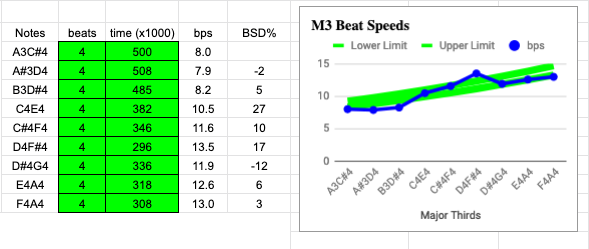
BEAT SPEED PROGRESSIONS YOUR M3 RESULTS: 82% (Goal 80%)
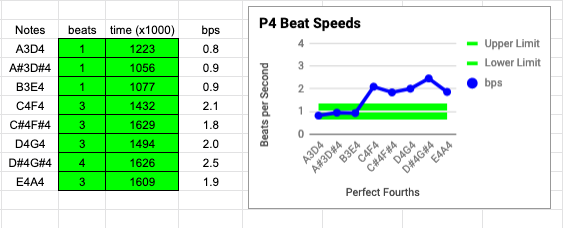
<img class="tve_image wp-image-14684 jetpack-lazy-image" alt data-id="14684" width="936" data-init-width="1064" height="248" data-init-height="282" title="john-s-M3" loading="lazy" src="https://howtotunepianos.com/wp-content/uploads/2020/05/john-s-M3.png" data-width="936" data-height="248" data-lazy-srcset="https://i2.wp.com/howtotunepianos.com/wp-content/uploads/2020/05/john-s-M3.png?w=1064&ssl=1 1064w, https://i2.wp.com/howtotunepianos.com/wp-content/uploads/2020/05/john-s-M3.png?resize=768%2C204&ssl=1 768w" data-lazy-sizes="(max-width: 936px) 100vw, 936px" data-lazy-src="https://howtotunepianos.com/wp-content/uploads/2020/05/john-s-M3.png?is-pending-load=1" srcset="data:image/gif;base64,R0lGODlhAQABAIAAAAAAAP///yH5BAEAAAAALAAAAAABAAEAAAIBRAA7"><noscript><img class="tve_image wp-image-14684" alt="" data-id="14684" width="936" data-init-width="1064" height="248" data-init-height="282" title="john-s-M3" loading="lazy" src="https://howtotunepianos.com/wp-content/uploads/2020/05/john-s-M3.png" data-width="936" data-height="248" srcset="https://i2.wp.com/howtotunepianos.com/wp-content/uploads/2020/05/john-s-M3.png?w=1064&ssl=1 1064w, https://i2.wp.com/howtotunepianos.com/wp-content/uploads/2020/05/john-s-M3.png?resize=768%2C204&ssl=1 768w" sizes="(max-width: 936px) 100vw, 936px" /> YOUR P4 RESULTS
<img class="tve_image wp-image-14683 jetpack-lazy-image" alt data-id="14683" width="628" data-init-width="628" height="257" data-init-height="257" title="john-s-P4" loading="lazy" src="https://howtotunepianos.com/wp-content/uploads/2020/05/john-s-P4.png" data-width="628" data-height="257" data-lazy-src="https://howtotunepianos.com/wp-content/uploads/2020/05/john-s-P4.png?is-pending-load=1" srcset="data:image/gif;base64,R0lGODlhAQABAIAAAAAAAP///yH5BAEAAAAALAAAAAABAAEAAAIBRAA7"><noscript><img class="tve_image wp-image-14683" alt="" data-id="14683" width="628" data-init-width="628" height="257" data-init-height="257" title="john-s-P4" loading="lazy" src="https://howtotunepianos.com/wp-content/uploads/2020/05/john-s-P4.png" data-width="628" data-height="257"> HOW TO USE THE GRAPHS AND AUDIO TO IMPROVE YOUR EAR
1. Listen to the recordings while looking at the graphs.
2. Listen to the filtered recordings and try to confirm aurally that the beat speeds are following what the graph says.
This improves your "Beat Speed Difference Sensitivity" - Your ability to hear small differences in beat speeds.
3. Listen to the unfiltered recordings and try to hear the specific beating partial within the unfiltered recording.
This improves your "Tuner's Ear" - Your ability to filter frequencies at will.
GRADING OF THE TEMPERAMENT
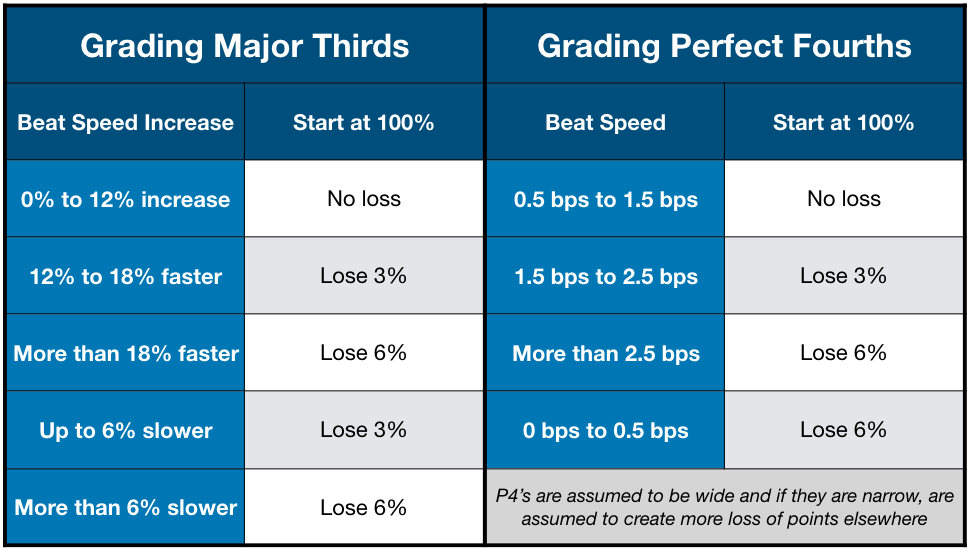
<img class="tve_image wp-image-14700 jetpack-lazy-image" alt data-id="14700" width="571" data-init-width="971" height="326" data-init-height="553" title="Screen Shot 2020-05-05 at 11.31.17 PM" loading="lazy" src="https://howtotunepianos.com/wp-content/uploads/2020/05/Screen-Shot-2020-05-05-at-11.31.17-PM.png" data-width="571" data-height="326" data-css="tve-u-171e80bb974" style data-lazy-srcset="https://i0.wp.com/howtotunepianos.com/wp-content/uploads/2020/05/Screen-Shot-2020-05-05-at-11.31.17-PM.png?w=971&ssl=1 971w, https://i0.wp.com/howtotunepianos.com/wp-content/uploads/2020/05/Screen-Shot-2020-05-05-at-11.31.17-PM.png?resize=768%2C437&ssl=1 768w" data-lazy-sizes="(max-width: 571px) 100vw, 571px" data-lazy-src="https://howtotunepianos.com/wp-content/uploads/2020/05/Screen-Shot-2020-05-05-at-11.31.17-PM.png?is-pending-load=1" srcset="data:image/gif;base64,R0lGODlhAQABAIAAAAAAAP///yH5BAEAAAAALAAAAAABAAEAAAIBRAA7"><noscript><img class="tve_image wp-image-14700" alt="" data-id="14700" width="571" data-init-width="971" height="326" data-init-height="553" title="Screen Shot 2020-05-05 at 11.31.17 PM" loading="lazy" src="https://howtotunepianos.com/wp-content/uploads/2020/05/Screen-Shot-2020-05-05-at-11.31.17-PM.png" data-width="571" data-height="326" data-css="tve-u-171e80bb974" style="" srcset="https://i0.wp.com/howtotunepianos.com/wp-content/uploads/2020/05/Screen-Shot-2020-05-05-at-11.31.17-PM.png?w=971&ssl=1 971w, https://i0.wp.com/howtotunepianos.com/wp-content/uploads/2020/05/Screen-Shot-2020-05-05-at-11.31.17-PM.png?resize=768%2C437&ssl=1 768w" sizes="(max-width: 571px) 100vw, 571px" /> INSIGHTS Equal Temperament , and Wide, Narrow, and Pure Intervals ,
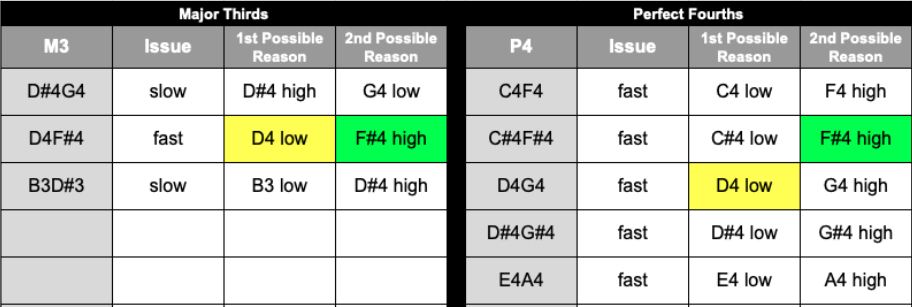
Traditional Refinement Procedure (Obsolete) In refining a temperament, we identify two or more problems that suggest the same note may be too high or too low, and then change that note to fix multiple problems.
This reiterative method helps us improve the temperament bit by bit.
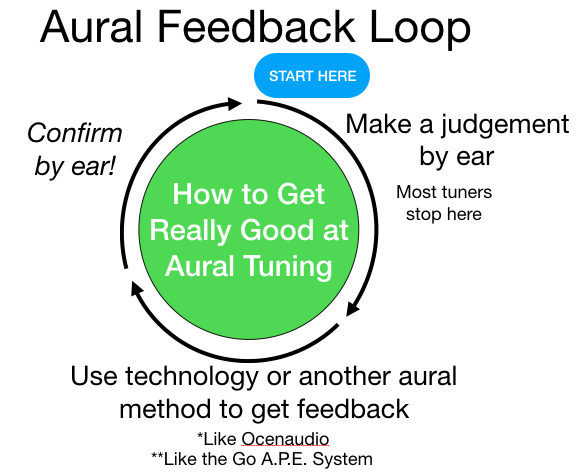
This is why it is imperative that, if you want to improve your aural tuning, you must improve your beat speed recognition.
Exercises like these can help greatly.
You are encouraged to read the analysis and confirm aurally that you can hear the findings, and understand how the improvements suggested would improve the beat speed progressions.
In this way, you will improve your ability to rationalize the logic, and improve your ear to be able to hear smaller and smaller beat speed differences.
Improving these skills will greatly improve your temperament.
Keep up the good work and don't give up! You're getting better all the time! Mark
<img class="tve_image wp-image-14700 jetpack-lazy-image" alt data-id="14700" width="571" data-init-width="971" height="326" data-init-height="553" title="Screen Shot 2020-05-05 at 11.31.17 PM" loading="lazy" src="https://howtotunepianos.com/wp-content/uploads/2020/05/Screen-Shot-2020-05-05-at-11.31.17-PM.png" data-width="571" data-height="326" data-css="tve-u-171e80bb974" style data-lazy-srcset="https://i0.wp.com/howtotunepianos.com/wp-content/uploads/2020/05/Screen-Shot-2020-05-05-at-11.31.17-PM.png?w=971&ssl=1 971w, https://i0.wp.com/howtotunepianos.com/wp-content/uploads/2020/05/Screen-Shot-2020-05-05-at-11.31.17-PM.png?resize=768%2C437&ssl=1 768w" data-lazy-sizes="(max-width: 571px) 100vw, 571px" data-lazy-src="https://howtotunepianos.com/wp-content/uploads/2020/05/Screen-Shot-2020-05-05-at-11.31.17-PM.png?is-pending-load=1" srcset="data:image/gif;base64,R0lGODlhAQABAIAAAAAAAP///yH5BAEAAAAALAAAAAABAAEAAAIBRAA7"><noscript><img class="tve_image wp-image-14700" alt="" data-id="14700" width="571" data-init-width="971" height="326" data-init-height="553" title="Screen Shot 2020-05-05 at 11.31.17 PM" loading="lazy" src="https://howtotunepianos.com/wp-content/uploads/2020/05/Screen-Shot-2020-05-05-at-11.31.17-PM.png" data-width="571" data-height="326" data-css="tve-u-171e80bb974" style="" srcset="https://i0.wp.com/howtotunepianos.com/wp-content/uploads/2020/05/Screen-Shot-2020-05-05-at-11.31.17-PM.png?w=971&ssl=1 971w, https://i0.wp.com/howtotunepianos.com/wp-content/uploads/2020/05/Screen-Shot-2020-05-05-at-11.31.17-PM.png?resize=768%2C437&ssl=1 768w" sizes="(max-width: 571px) 100vw, 571px" /> Conclusions
The M3's are good. You should have been able to hear the drop in the D#4G4 but maybe not since this was an A3A4 temperament. That is why we use the F3F4 temperament; the beats are slower and easier to hear.
However, there do not seem to be any obvious clues as to what to do. That's probably because the lead up to D4F#4 was smooth but too steep - from B3D#4 to D4F#4 the average increase was 18%. The mathematical increase is 5.95%.
This implies the D4F#4 is really the error here, which would have been hard to pick out without a lot of experience on what a 6% increase sounds like.
The too low D4 created a too fast D4G4, and the too high F#4 created the too fast C#4F#4.
The too fast C4F4 also produced a low C4 and a high F4 which resulted in the too fast C4F4. But again, hard to catch because of the steep increase from B3D#4 to D4F#4.
IMPORTANT
This is a traditional refinement procedure.
The Go A.P.E. Sequence allows to to self correct before you are finished .the way they were tuned. (No searching high and low for reasons why a note is wrong)
<img class="tve_image wp-image-15501" alt="" data-id="15501" width="383" data-init-width="577" height="316" data-init-height="475" title="loop" loading="lazy" src="https://howtotunepianos.com/wp-content/uploads/2020/05/loop.png" data-width="383" data-height="316" ml-d="0" style="" data-css="tve-u-1722947c3e8"> <img class="tve_image wp-image-15502" alt="" data-id="15502" width="383" data-init-width="360" height="278" data-init-height="261" title="Go-APE-1" loading="lazy" src="https://howtotunepianos.com/wp-content/uploads/2020/05/Go-APE-1.jpg" data-width="383" data-height="278" ml-d="0" style="" data-css="tve-u-1722947c3e8">