
Unison Theory Lesson 4
Double String Unison, DSU
If you can learn how to use DSU, it may be the number one thing that changes your tuning forever!
The most common way to tune a piano is to insert a mute strip between notes so that each note has only the center string free to vibrate.
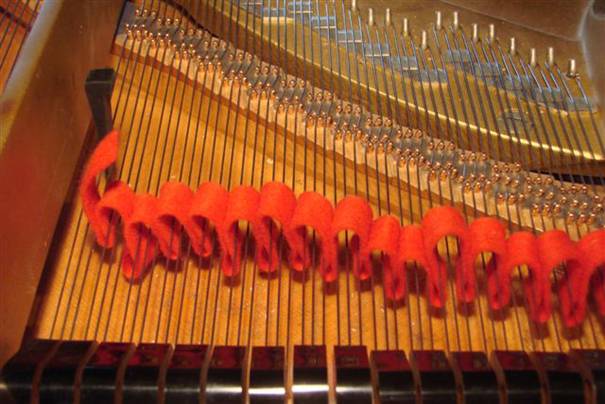
Piano Tuning Mute Strip
The benefit of using a mute strip is you can set pitches without worrying about having to get clean stable unisons.
The problem with using a mute strip is you don't learn how to set unisons that are clean and stable.
Beginning technicians often choose to ignore learning this skill because it is too hard, too boring, and they don't understand how important it is.
"Ignore mastering pure, stable unisons and your tunings will always be poor and you will never get important customers and no professional musician will ever be impressed with your tunings."
Double String Unison, or DSU, is the secret weapon to learning how to tune clean, stable unisons, and getting tons of happy customers!
DSU is a type of open unison tuning technique.
Tuning open unisons means you tune all three strings of a trichord clean before moving on to the next note. Tuning open unisons means your unisons must be clean if they are to be good references for tuning the next notes, and because the unison is tuned early, there is plenty of time for the unison to drift out-of-tune if it isn't stable.
All open unison tuning techniques (except DSU) involve inserting a mute into the tiny space between two strings of the same note.
Struggling to insert a rubber mute
This is just one area where DSU shines!
Since DSU means never tuning a single string, you never have to mute two strings of the same note. We only ever mute one string, leaving the DSU - two string unison - free to be tuned. There is plenty of room between the notes to insert the mute for DSU.
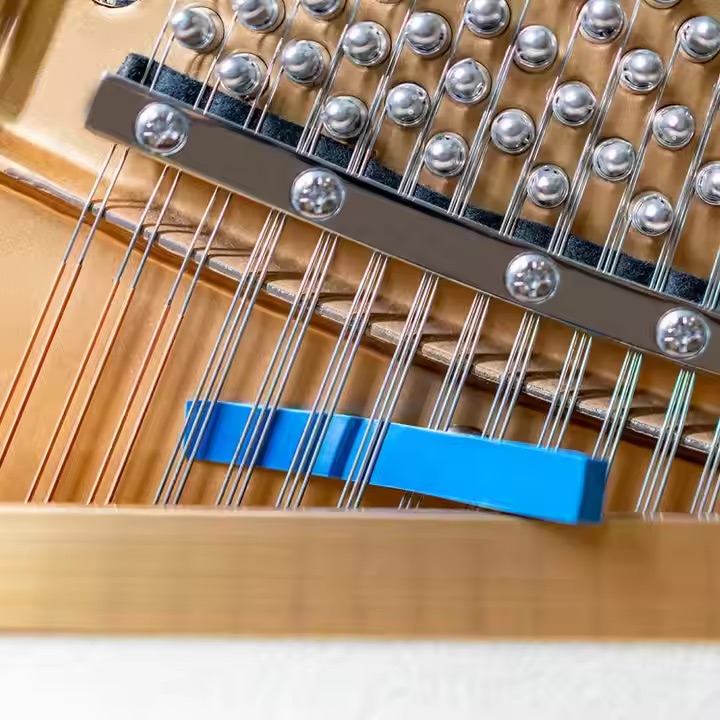
How to Use DSU
The idea is pretty simple; tune two strings to sound like one, then judge the pitch. If you need to move the pitch, move one string, then the other.
The majority of tuning methods advocate tuning a single string while listening to the sound of the interval. The problem with this technique is you are relying your ear to know what the interval is supposed to sound like. This is why beginners take forever to get good. The Mark Cerisano Tuning System taught at the International Piano Technicians School teaches beginners to set interval sizes using beat rates, which is a much more accurate technique, and only one of the reasons why beginners are getting concert level results in as little as four months. (See my interview with concert student Stephen Struwve and concert technician, Kevin Knopp.)
Step-by-Step DSU Procedure
1) Mute one string of the trichord (Not needed for bichords ?) This creates the DSU; the double string unison of two strings.
2) Tune the DSU clean.
3) Judge the Pitch.
How this is done depends on the note you are tuning and the system you are using.
Examples using the Mark Cerisano Tuninmg System:
Tuning A4: We measure it with an ETD.
Tuning A3: We play the M3/M10 and m3/M6 tests and try to tune a pure 4:2/pure 6:3.
Most Notes in the Treble: We tune the note so it creates a medium speed with another tuned note that beats between two slow and fast intervals that have also already been tuned.
If the pitch is good, and this is a trichord, go to step 6. If it is a bichord, you are done. ?
If the pitch needs to be moved, go to step 4.
4) Move one string in the direction you want to go. Becasue this is a DSU, the out-of-tuness of the DSU will indicate how far you've moved the string.
5) Move the other string when you think you've moved the first string the correct distance, making the DSU clean again.
Go to step 3 and judge the pitch again.
6) Remove the mute.
7) Tune the third string to the DSU.
DSU EXAMPLE
Listen to this example of me tuning a clean octave of two trichords using DSU and Beat Matching.
Notes:
- The steps are not exactly the DSU steps above because this is primarily a Beat Matching example.
- This was created before I had fully developed the Small/Medium/Large inharmonicity theory. In the video I say this is a wide 4:2 / narrow 6:3, but I can't hear it. I would call this a small scale octave tuned as a pure 4:2 / pure 6:3 where M3 = M10 and m3 = M6, as far as my ears can tell.
The Benefits of DSU over Single String Open Unison
(These are the reasons I never adopted open unison even though I knew it was more accurate, until I discovered DSU.)
Look at the table below to see the benefits of double string versus single string open unison tuning.
Single String Open Unison Tuning - Tuning the single string to the target pitch before adding the other two strings to make the final clean unison.
Double String Open Unison Tuning - Tuning two strings as a clean unison to the target pitch before adding the third string to make the final clean unison.
Benefit | Single String Open Unison Technique | DSU Open Unison String Technique |
|---|---|---|
⭐️ Unisons must be clean to be used as references. | ||
⭐️ Unisons tuned early means more time to catch poor stability. | ||
⭐️ Weinreich Drift is not an issue | ||
⭐️ Easier to insert mutes! | ||
⭐️ Less mutes falling into piano! | ||
⭐️ Less mute movement! | ||
⭐️ Less mutes needed! | ||
⭐️ No mutes needed for bichords! | ||
⭐️ More precise pitch adjustments! | ||
⭐️ Direct feedback, better stability! | ||
⭐️ Beat matching option means faster tunings! | ||
⭐️ No need to put Papp's mute under hammer heads in the treble! | ||
⭐️ No need for Papp's mutes in treble at all! | ||
⭐️ Can move pitch as little as 0.3 cents! | ||
⭐️ Precise pitch movement! |