Free Unisons and Stability Course
Lesson 2 - Unison Basics
Tuning unisons is arguably one of the most important skills in piano tuning.
An out-of-tune unison is the most common reason you will be called back to a customer's home. Actually, the most probably outcome is that the customer "ghosts" you - refuses to return your messages. This is the piano tuner's way of getting FIRED!
So, what is an in-tune unison, and how do we produce one?
Well, producing one involves a few more descriptions and practice, but describing scientifically what one is, is relatively simple.
It is highly recommended that you check out my videos on the following subjects if you are not familiar with the topics:
The Harmonic SeriesWhat Does an In-Tune Unison Sound Like?
First, remember that whenever we play a string, there are multiple simultaneous frequencies produced that are called partials.
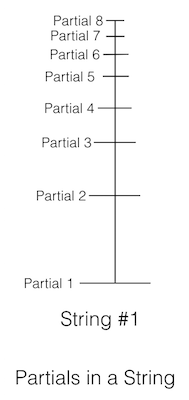
Click the button below named [Single String]. You will hear what appears to be the one frequency of that single string.
The [Single String] button is playing all those notes, plus more, all at the same time. Those are the partials of a note and every musical note has partials.
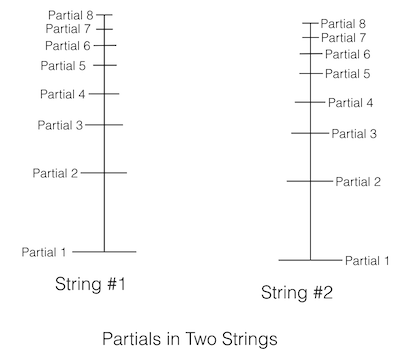
Two strings that are matched, should have the same partials. See the figure below that shows two strings of the same note.
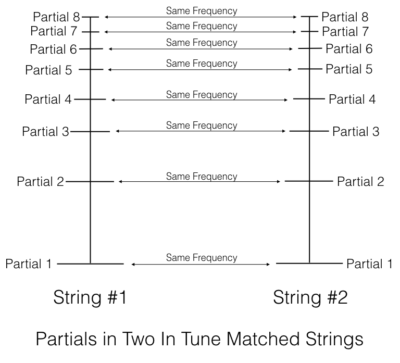
When these two strings are at the same frequency, then each of the partial pairs will have the same frequency and there will be no beating at any partial, as shown in the diagram below:
If the strings are not at the same frequency, there will be beating at the higher partials as shown in the figure below:
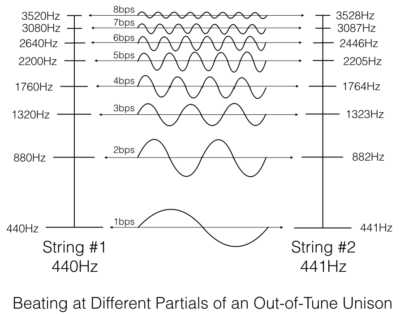
You need to know that the higher the partial, the faster the beating, which is why, as tuners, always try to tune the higher partials of a unison beatless as a minimum. If you can't hear the higher partials, you will NOT be able to tune clean unisons. Work on that! Start now! Try the exercise below.
What Does an Out-of-Tune Unison Sound Like?
to listen to an out of tune unison.
but can you hear each of the higher partials beating,
at a different speed, at will?
That is one of the most important skills of a good aural tuner. That is what you HAVE to learn to do if you want to learn how to tune a piano by ear.
Click each of the [Partial #] buttons below to hear a filtered recording of the out of tune unison above, with the first eight partials filtered out.
EXERCISE: Click the [Partial 5] button below.
Check your inbox tomorrow for Lesson 3!