The Go A.P.E. Aural Piano Tuning Sequence is the most accurate sequence available to aural tuners.
The accuracy comes from the beat speed windows which make pitch setting easy and accurate.
Part of the accuracy comes from the "end in mind" or "big picture" principle of tuning all M3's progressively from the start.
To do this when we do not have M3's already tuned, we use "surrogate" M3s. These are M6 or m3 that beat the same speed as the M3 that will beat halfway between the slow and fast intervals of the window when the tuning is finished.
We use the M3/M6 equality to determine the surrogate M6.
And then based on the size of the 6:3 tuned, which depends on the inharmonicity of the piano, we get the m3 equality, if we need it. For example, for small scale, 6:3 are pure, i.e. m3 = M6, and the M3/M6 equality gives us the m3/M3 equality for small scale pianos.
The problem is, the M3/M6 equality is flawed. For any M3/M6 equality, the M6 should beat faster than the M3 by 1.87% (Mathematically, not considering inharmonicity, but that is not a big deal here. The actual differences are similar in real pianos.)
This means that every time you use the M3/M6, which is every time we use a surrogate M3, you tune the note flat, but since it's only 1.87% you can't hear it anyway.
However, we keep using the M3/M6 equality and the error accumulates. When get the the end of the sequence, we may end up with a cummulative error that we can hear.
Below are the notes tuned in order and their error.
0% Error (1st augmented chord - the skeleton)
A4
A3
F3
F4
C#4
2% Error (2nd augmented chord)
D4
F#3
A#3
4% Error (3rd augmented chord tuned from the 2nd augmented chord)
D#4
B3
G3
6% Error (4th augmented chord tuned from the 3rd augmented chord)
E4
C4
G#3
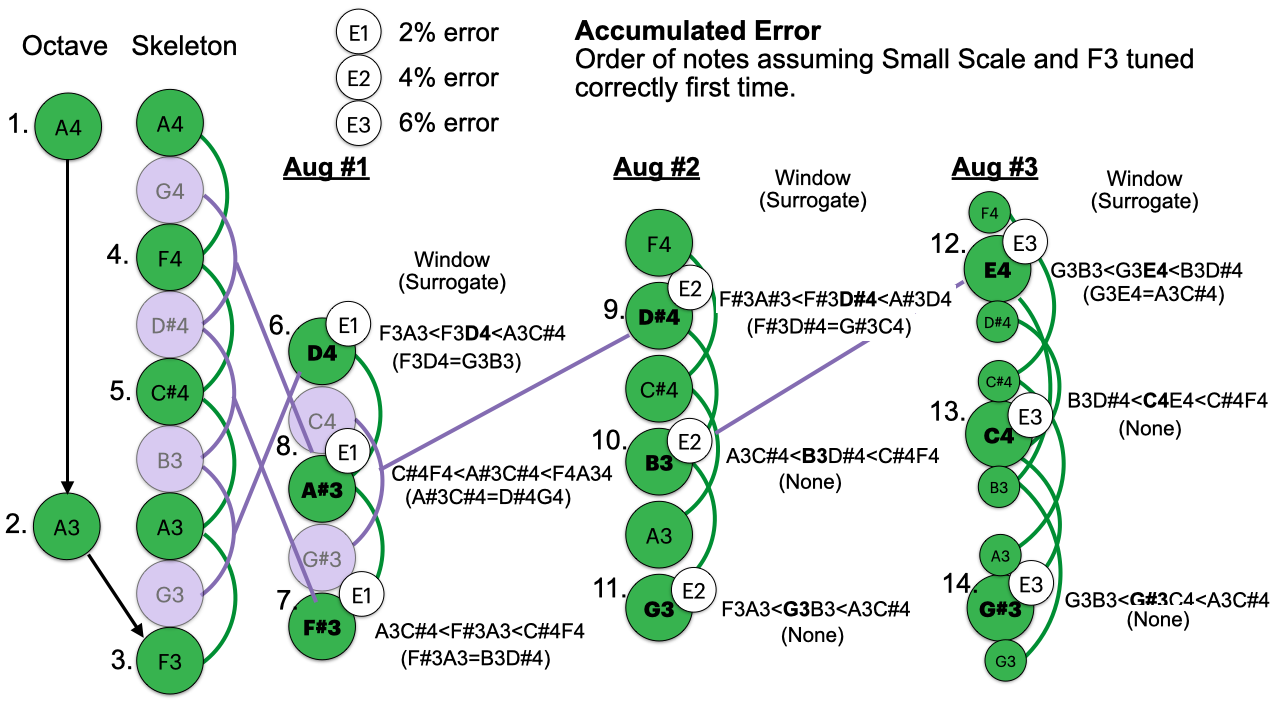
Order of Notes Tuned and Error Produced
What Does this Mean?
If we look at the P4 and P5 that the 6% error group makes with the 0% error group, we get the following:
A3E4 too narrow
E4A4 too wide
F3C4 too narrow
C4F4 too wide
G#3C#4 too wide
Notice that G#3 and C4 of the 6% error group are tuned from other M3s that have similar errors so their speeds are not affected and therefore the M3s will not help us find the errors.
Example: Checking G#3.
G#3 was tuned using chromatic M3's:
G3B3 < G#3C4 < A3C#4
G3B3 is in the 3rd augmented chord, 4% error.
G#3C4 is in the 4th augmented chord, 6% error.
A3C#4 is in the 1st augmented chord, 0% error.
G3B3 < G#3C4 < A3C#4
Since each M3 interval note has the same error, the beat speed is not affected and the tests pass, even though the notes are wrong.
What To Do.
Because C4 is tuned from E4, and G#3 is tuned from C4, that means their error comes from E4. So, you may save a lot of time by going straight to E4 and fixing it.
How to Fix E4.
The Go A.P.E. System works with "permissions". These allow us to focus on notes that we know are wrong and not worry about notes that we think are wrong.
Also, when refining, we don't look for notes to agree with their criteria, we look for notes that don't agree with their criteria.
And finally, before we check a note, we determine in which direction we need to note to go, and then we check it the way it was originally tuned, looking for "permission" to move it in the direction we need it to go.
This usually results in us checking a note to make sure it creates a medium speed within the window that tuned it; the window producing slow-medium-fast speeds.
Or more accurately, hoping that the middle interval does not produce slow-medium-fast speeds. We are looking for the middle interval to beat too fast or too slow, depending on how we want to move the note of the interval we are refining.
Example: Playing A3D4 we find it is too wide. A3 is too low or D4 is too high.
In checking D4 we hope we can lower it. We play the window that tuned it, F3A3 < F3D4 < A3C#4, and "hope" that F3D4 is closer to A3C#4, faster than medium; we look for "permission" to lower D4.
Now when it comes to E4 we may find that it fits the slow-medium-fast criteria.
G3B3<G3E4<B3D#4, slow-medium-fast
However, since E4 has an error of 6% flat, we have permission to raise it even if it agrees with the criteria.
To explain this another way, when checking E4, we can look for a slow - medium fast - fast relationship where G3E4 is closer to B3D#4.
G3B3-------G3E4--B3D#4 instead of G3B3----G3E4----B3D#4
But remember, we don't waste time trying to create this relationship when tuning E4, we only use this knowledge when looking for permission to refine E4 after it is tuned, IF we find interval errors with G#3 and/or C4.
We can also use this when tuning D#4 which has a 4% error, but this is harder to hear.
i.e. If D#4 fits like this:
F#3A#3----F#3D#4----A#3D4
and we are looking for permission to raise D#4, we got it, because D#4 is 4% flat if everything is precise, so raising it would improve it. So, this is ok:
F#3A#3-------F#3D#4--A#3D4
Here is a class video where I go into more detail about equal temperament, the M3/M6 equality, and the errors produced in th Go A.P.E. sequence.