
Free Unisons and Stability Course
Lesson 6 - Putting It All Together
(Note; The terms "clean", "pure", and "beatless" are used interchangeably in this lesson.)
Now that you understand the importance of unisons and stability, and how to confirm if they are good, here are some techniques to help you get these unisons clean and stable more easily.
Tuning with Double String Unison for Aural and ETD Tuners
Whether you tune by ear or with an app, you still need to get clean and stable unisons. The Double String Unison technique, although it was primarily developed for aural tuning, can also be used for ETD tuning.This section deals mostly with the benefits of DSU in aural tuning. The next section shows you how to use DSU with an ETD.
What is Double String Unison, and Why Are People Raving About It?
Soon after I started tuning pianos, I started hearing about open unison tuning techniques. I was intrigued because it sounded like an advanced technique and I was interested in developing my tuning technique as much as possible. However, I could find nothing written on the subject and nobody could tell me how it worked. I decided to learn how to do it on my own.
Open Unison Tuning Techniques
An open unison tuning technique is one where the tuner tunes the unison clean before moving on to the next note. The unison must be tuned beatless for it to be used as a reference note for tuning future notes or it will be useless. Also, since the unison is tuned first and early in the sequence, there is more time to catch it, if it drifts.
An open unison tuning technique places more emphasis on the unison to be pure and gives us more opportunity to find and fix unisons that are not pure.
Mute Strip Tuning
Tuning with a mute strip leaves the task of tuning unisons until the end. Then if they are unstable, they will slip only after the tuner leaves, unless the tuner takes extra care to make sure they are stable, which many do not.
One benefit of open unison tuning is that the tuner doesn’t have to make sure the unisons are stable; the technique demands that they must be beatless and stable, and if they slip, chances are, the tuner will catch it.
Single and Double String Open Unison Technique.
Single string open unison is when the tuner mutes two strings of a trichord, (or one string of a bichord), tunes the single string, adds a second string, and then tunes the third to make a beatless unison.
Double string open unison is when the tuner mutes only one string of a trichord, (with DSU you do not use a mute with bichords), and then tunes the double string unison (DSU) beatless, checks it to see which way it should move to be in tune, then detunes the DSU by moving one string in that direction, and follows with the second string to clean it up. The DSU is checked and moved this way until the tuner is happy with the result.
I can’t remember how I stumbled upon the DSU technique, perhaps I was intrigued by the challenge. I had heard of technicians tuning two strings at once and thought, “This is crazy. How is it possible?”. Anyway, I began to experiment with it and discovered how powerful a technique it is.
Once I started using DSU, I was amazed at how many benefits it had compared to the few benefits of single string open unison, In fact, there are so few benefits to single string unison, that it is no wonder to me why more people don’t use it.
Watch Me Use DSU
In the video below, I am tuning G4 to be a pure 4:2 and confirm a wide P4 and narrow P5.
Here is how I did it:
1) I assumed G3 was correct.
2) Then I played D#3-G3 and D#3-G4 and tuned G4, using DSU, so that they were the same speed. i.e. D#3=G3 = D#3-G4. This is the M3/M10 test for the 4:2 octave.
3) Then I checked the M6, D#3-C4, and confirmed it was a bit faster.
That meant D#3-G3 was a bit slower than D#3-C4.
D#3-G3 < D#3-C4
M3 < M6, this test confirms the P4, G3-C4, is wide, which it is supposed to be.
Since D#3-C4 was a bit faster, that meant it was also faster than D#3-G4.
D#3-C4 > D#3-G4
M6 > M10, this test confirms the P5, C4-G4, is narrow, which it is supposed to be.
The Benefits of Using Double String Unison versus Tuning Open Unisons with Single Strings
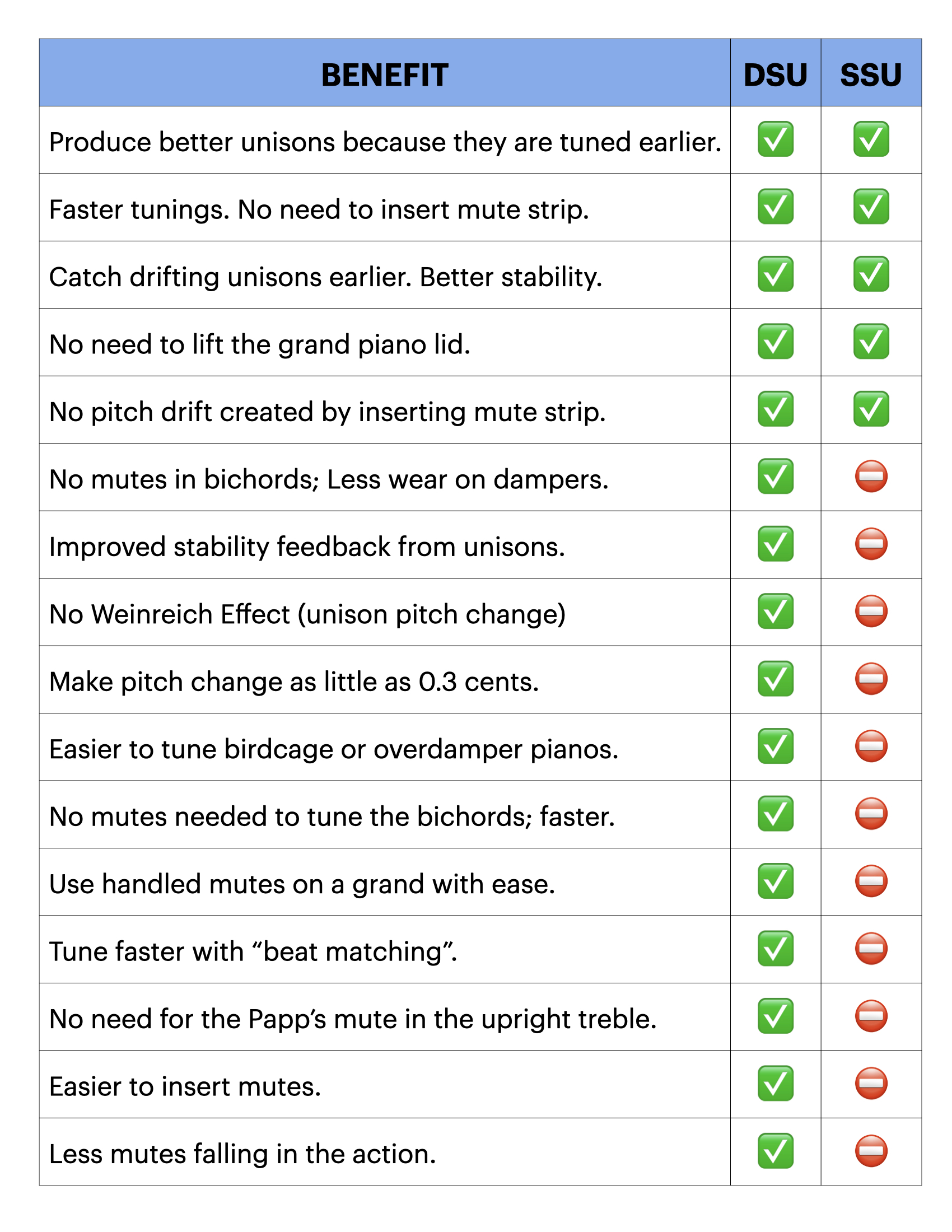
Another DSU Example - Tuning A3-A4 Using iH and DSU
Using DSU With An ETD
The Mark Cerisano Tuning System is a completely aural tuning system, except we tune A4 using an ETD instead of a tuning fork because the ETD is easier, more precise, more accurate, and more efficient
We also use DSU to tune A4, but you could use an ETD and DSU and tune the whole piano that way. In fact, I just created a course that explains how to do this with Piano Meter.
Here again is the DSU Procedure:
1) Mute all but one string.
2) Tune the other two strings clean.
3) JUDGE
Here is where the Mark Cerisano Tuning System has a bunch of different criteria to listen for depending on what note you are tuning, but when tuning A4, the criteria is just to tune A4 to the ETD. You can do this for all the notes; just measure each DSU with an ETD, like PianoMeter
IF THE DSU IS GOOD, GO TO STEP 6.
4) If the DSU needs to go up or down, move one string.
5) Move the other string and make another clean DSU
GO BACK TO STEP 3.
6) Remove the mute.
7) Tune the 3rd string clean to the DSU
The following video is from the ETD Tuning Course. It shows how we use DSU with an ETD.
The following video is from the same course. It shows how we use the ETD with DSU to tune the midrange trichords.
Check out your inbox tomorrow for our last lesson in the FREE Unison and Stability course.