

Music Theory Quiz for Piano Tuners
Below, you will find 20 questions - five for each music theory concept you should know to study piano tuning.
Note: Piano tuners do not use flats.
They also name intervals as pictures to reduce the numerous possibilities that formal music theory produces.
E.g. in C# major, the third note is E#. But, when discussing piano tuning theory, we see an F, never an E#. I.e. when we are looking at the piano, without anyone telling us what key we are in, we see Db-F as a M3, but we see Db as C#. So, C#-F is a M3 when discussing piano tuning theory.
Another example: Piano tuners don't have multiple names for notes or intervals. F to A# is a P4 because it looks like a P4 when you are looking at it at the piano, and we don't use flats. So, F to A# is a P4.
Formal music theory is required to write and compose music. When discussing piano tuning theory, we don't need formal music theory, or the extra complications it produces.
If this is too much for you, consider not learning how to tune pianos, because the piano tuner's system of naming notes and intervals is not going away anytime soon.
If you take the time to add this system to the many ways that you already know how to name notes, you will find that it makes things much easier in the long run.
Keep this in mind when answering the questions below
Choose the correct answer for each question by clicking the small circle to the left of the correct answer. When you are done, click the SCORE button to find out how well you did.
Results will be displayed below.
Choose the correct answer for each question by clicking the small circle to the left of the correct answer. When you are done, click the SCORE button to find out how well you did.
PART A Name the following notes using standard piano tuner conventions - lowest A = A0, no flats, just sharps.
#1: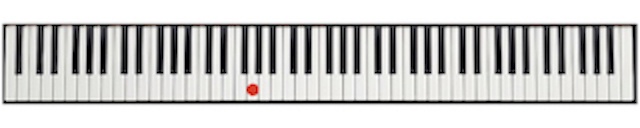 |
| a) D2 |
| b) G3 |
| c) D3 |
| d) G2 |
#2:  |
| a) C#2 |
| b) Db2 |
| c) C#3 |
| d) Both a and b |
#3: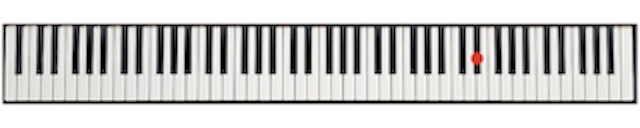 |
| a) D#5 |
| b) Eb6 |
| c) D#6 |
| d) Both b and c |
#4: 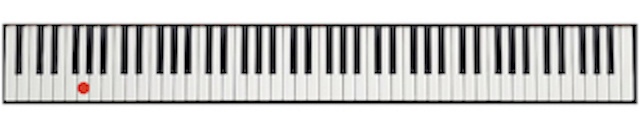 |
| a) G1 |
| b) F1 |
| c) A1 |
| d) G0 |
#5: 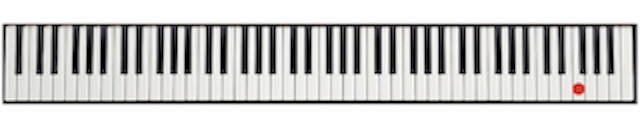 |
| a) C7 |
| b) F6 |
| c) F8 |
| d) F7 |
PART B Name these intervals. Just use m3, M3, P4, P5, m6, M6.
#6: 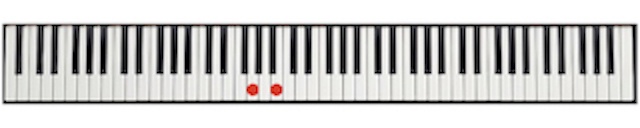 |
| a) m3 |
| b) P4 |
| c) M3 |
| d) P5 |
#7: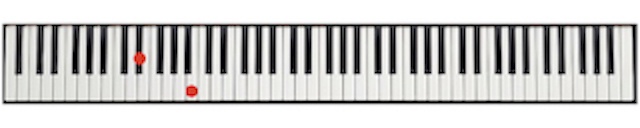 |
| a) P5 |
| b) M6 |
| c) m6 |
| d) None of the above |
#8: 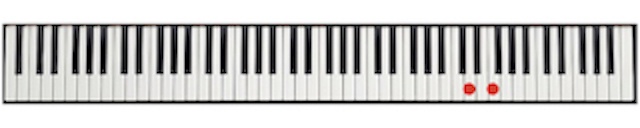 |
| a) m3 |
| b) M3 |
| c) P4 |
| d) Both a and b |
#9: 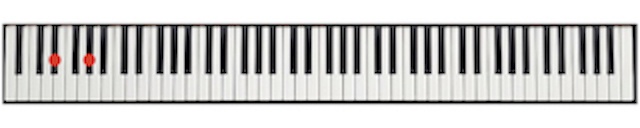 |
| a) P4 |
| b) M3 |
| c) d5 |
| d) P5 |
#10: 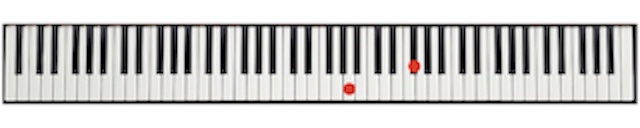 |
| a) P5 |
| b) m6 |
| c) M6 |
| d) None of the above |
PART C Name these compound intervals. Just choose M10, M17, P11, P12, P19, P22.
#11: 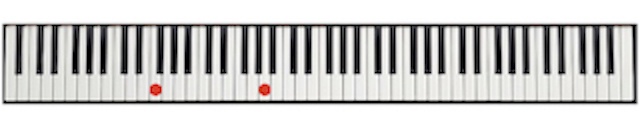 |
| a) Perfect Octave |
| b) M3 |
| c) M10 |
| d) None of the above |
#12: 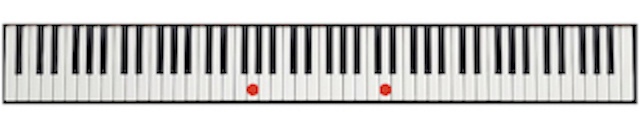 |
| a) P11 |
| b) P12 |
| c) An Octave and a fourth |
| d) P15 |
#13: 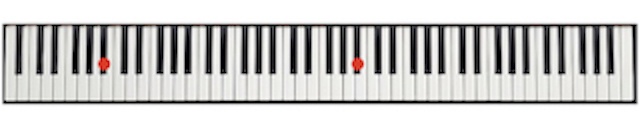 |
| a) Double octave (P15) |
| b) P19 |
| c) P21 |
| d) None of the above |
#14: 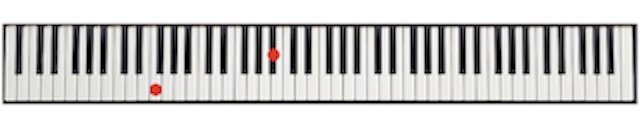 |
| a) P11 |
| b) P12 |
| c) P15 |
| d) P22 |
#15: 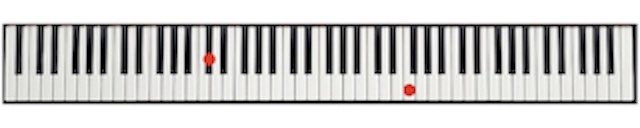 |
| a) M3 |
| b) M17 |
| c) P11 |
| d) P12 |
PART D Name these notes, using standard piano tuning conventions, given the interval, starting note and direction. Example: A M3 above C is? (The answer is E):
| #16: A m6 above C#? |
| a) E |
| b) A# |
| c) Bb |
| d) A |
| #17: A P5 above B? |
| a) G |
| b) F |
| c) Gb |
| d) None of the above |
| #18: A m6 below C? |
| a) E |
| b) F |
| c) Eb |
| d) D# |
| #19: A M3 below F? |
| a) C |
| b) D |
| c) Db |
| d) C# |
| #20: A M6 below C? |
| a) F |
| b) E |
| c) Eb |
| d) None of the above |
Results will be displayed below.
